

The Reverse KonMari Method
I’ve read all the books. Watched all the shows. Tried all the methods. But whenever I set out to declutter my home “once and for all,” I got overwhelmed, discouraged, or distracted — and gave up halfway through.
Then I discovered a new approach: the Reverse KonMari Method. Instead of tackling entire categories or asking every object if it “sparks joy,” I gave myself one simple rule:
30 minutes a day. One small zone. Done.
No pressure. No perfection. Just progress.
In this post, I’ll show you how to use the Reverse KonMari Method to gently declutter your home — even if you’re busy, tired, or easily overwhelmed.
Tidying Up with the KonMari Method: Origins, Joy, and Peace of Mind
I still remember the first time I heard about the KonMari method – the idea that tidying up could actually spark joy sounded almost too good to be true. The method was created by Japanese organizing consultant Marie Kondo, whose lifelong passion for tidying turned into a global movement. It all started with her best-selling book The Life-Changing Magic of Tidying Up (first published in Japan in 2011 and later worldwide in 2014), which introduced the world to her unique approach.
Kondo’s approach was heavily influenced by her culture and personal experiences. In fact, she spent five years as an attendant maiden at a Shinto shrine during her youth, and she once described a breakthrough moment as a teenager: after collapsing from stress, she awoke with a realization that tidying should focus on what to keep (what makes you happy) rather than what to throw away. This epiphany laid the groundwork for her famous criterion of keeping only items that “spark joy” (a phrase derived from the Japanese word tokimeku, meaning a heart flutter). The cultural origins of KonMari run deep – many observers note that the method aligns with Japanese traditions like Shinto, which teaches that even objects may carry a spiritual essence or energy. The practice of holding each item to see if it “sparks joy” reflects a kind of mindfulness and respect for objects that resonates with Shinto animism (the belief that spirits, or kami, inhabit the material world).
Kondo herself has acknowledged this influence (she even begins tidying sessions by “greeting” the house in a silent moment of thanks), though she also cautions that her approach is a personal blend rather than a strict religious practice.
Mental Health Benefits and Joyful Pros of KonMari
An organized, minimalist closet exemplifying the calm and clarity that can come from tidying up. One of the most powerful promises of the KonMari method is its mental health benefit. As someone who’s applied it in my own cluttered home, I can attest to the sense of calm and clarity that comes from a truly tidy space. I found it validating to learn that psychological research backs this up: clutter isn’t just a mild annoyance – it can significantly affect our brain and mood. Studies have shown that disorganization and excess clutter have a cumulative negative effect on our minds, raising stress and anxiety levels and even impairing focus and working memory.
In one study, neuroscience researchers found that clearing clutter from the home actually improved people’s ability to concentrate and be productive. Conversely, having a tidy, organized environment has been linked to lower cortisol (stress hormone) levels, less depression, and better overall well-being.
In fact, a large 2016 study of over 1,300 people found that the more clutter people had, the lower their life satisfaction – more stuff often meant less happiness. No wonder Kondo frames her method as “life-changing magic”: by discarding physical clutter, people often feel they are also tidying their mental and emotional clutter.
Personally, I’ve felt this magic: after a KonMari decluttering session, I not only see my clean closet, I feel lighter and more in control of my life. This method encourages you to identify what truly matters to you – keeping only the items that “speak to your heart”– and the result can be incredibly empowering. Many have reported reduced stress and a greater sense of peace after tidying; even families on Kondo’s Netflix show described instant positive effects on their mental health and relationships once their homes were in order.
An unexpected bonus is that KonMari also integrates gratitude into decluttering: you thank the items you let go, acknowledging the role they played in your life. This gentle, appreciative mindset can boost positive feelings – it’s in line with research showing that practicing gratitude increases happiness and life satisfaction. All these pros make the KonMari method feel not just like housework, but a form of self-care. By creating a living space that truly sparks joy, you cultivate a calmer mind and a home that supports your well-being.
Drawbacks and Criticisms: One Size Does Not Fit All
Still, KonMari isn’t perfect. Its all-at-once “tidying festival” can overwhelm those with depression or hoarding tendencies. Emotional attachments complicate decisions, and for many, throwing out useful items isn’t feasible. Critics point out the method assumes financial privilege—the ability to discard and later repurchase items if needed.
Even I felt conflicted discarding sentimental pieces. Plus, the trend of buying new organizing tools can ironically add more clutter. For me, the trick was resisting perfection and focusing on intention—not aesthetics, but meaning.
That is until I discovered the Reverse KonMari Method.
What Is the Reverse KonMari Method?
The traditional KonMari Method, made famous by Marie Kondo, involves gathering all your items by category (clothes, books, papers, etc.), holding each one, and deciding whether it “sparks joy.”
It’s powerful — but also time-consuming, emotional, and intense. Many people never finish.
The Reverse KonMari flips the process:
- You work room by room instead of category by category
- You work in daily 30-minute bursts
- You don’t handle everything at once — just one small space at a time
The goal isn’t minimalism. It’s momentum.
Why This Method Works (Especially If You’re Tired or Busy)
- Low time commitment: Anyone can find 30 minutes
- Less emotional burnout: You’re not making hundreds of decisions at once
- Built-in wins: You see results every single day
- Flexible: You can skip a day or change your plan and keep going
It meets you where you are — mentally and physically.
The 5-Step Daily Declutter Flow
🕒 Step 1: Set a 30-Minute Timer
This is your container. It keeps you focused and prevents overdoing it. You can use your phone timer, an app like Focus Keeper, or a simple kitchen timer.
📍 Step 2: Pick One Zone (Not One Category)
Choose one small, physical area. Examples:
- One drawer
- One shelf
- The kitchen junk basket
- Your nightstand
- One tote bag full of “stuff”
Don’t think big. Think bite-sized.
📦 Step 3: Pull Everything Out and Sort Fast
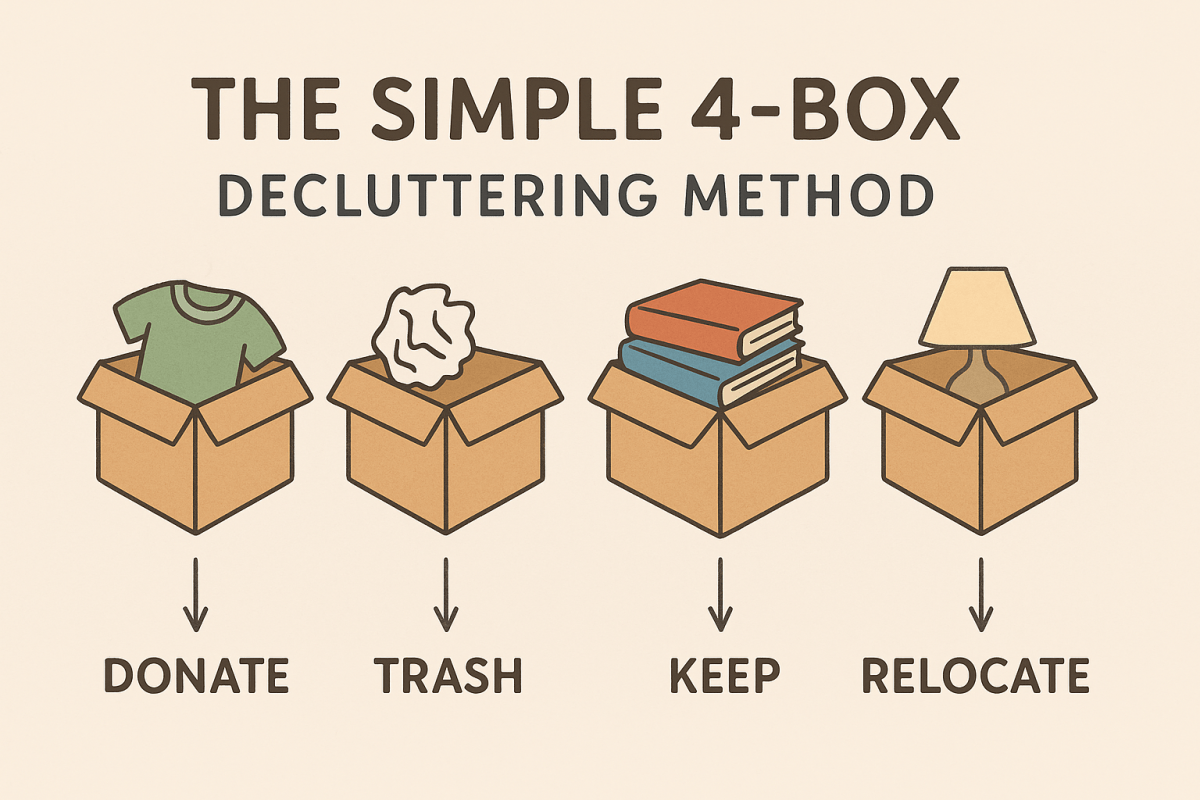
Empty the space and sort into 4 piles:
- Keep: Use it regularly and like it
- Donate: Useful, but not for you anymore
- Trash: Broken, expired, or no longer usable
- Relocate: Doesn’t belong here, but you still want it
Don’t overthink. If in doubt, put it in a “decide later” box.
🧺 Step 4: Return Only the Essentials
Wipe down the space. Then put back only what’s functional, useful, or beautiful to you — in a way that’s easy to see and access.
No bins? Use trays, jars, bowls, or boxes you already have.
📓 Step 5: Track Your Wins
Keep a “declutter log.” Write down what you cleared that day — even if it’s just “top kitchen drawer.”
This creates momentum and reminds you how far you’ve come.
Sample 7-Day Declutter Plan
- Day 1: Bathroom drawer
- Day 2: Bedroom nightstand
- Day 3: Pantry shelf
- Day 4: Desk top surface
- Day 5: Entryway shoe rack
- Day 6: One junk drawer
- Day 7: Clear your digital desktop or downloads folder
Rinse and repeat the next week — or adjust based on what your home needs most.
Bonus Tips to Stay Motivated
- Play music or a podcast while you work
- Take before/after photos — even if you don’t share them
- Pair it with a reward: tea, a walk, or 10 screen-free minutes
- Invite a friend to join you virtually for accountability
What I Noticed After 30 Days
- Less guilt about “stuff” I didn’t use
- More breathing room in every room
- Less visual noise — which helped with my brain fog
- More clarity in my decisions — clutter affects your mind more than you think
Why 30 Minutes Is Just Right
It’s long enough to make visible progress — but short enough to not feel like a chore. It fits into lunch breaks, lazy Sundays, or even while waiting for laundry to finish.
And over time? It transforms your space and your habits — one small step at a time.
Small Daily Decluttering Beats Big Weekend Chaos
You don’t need a whole week off. You don’t need fancy containers or life-changing magic. You just need a timer, a little intention, and one small win a day.
The Reverse KonMari Method isn’t about perfection — it’s about peace. And it starts with just 30 minutes today.
Discover more from Alternative Lifehack Ideas
Subscribe to get the latest posts sent to your email.
Pingback: 5 Micro-Habits That Had a Macro Impact on My Daily Life - Alternative Lifehack Ideas